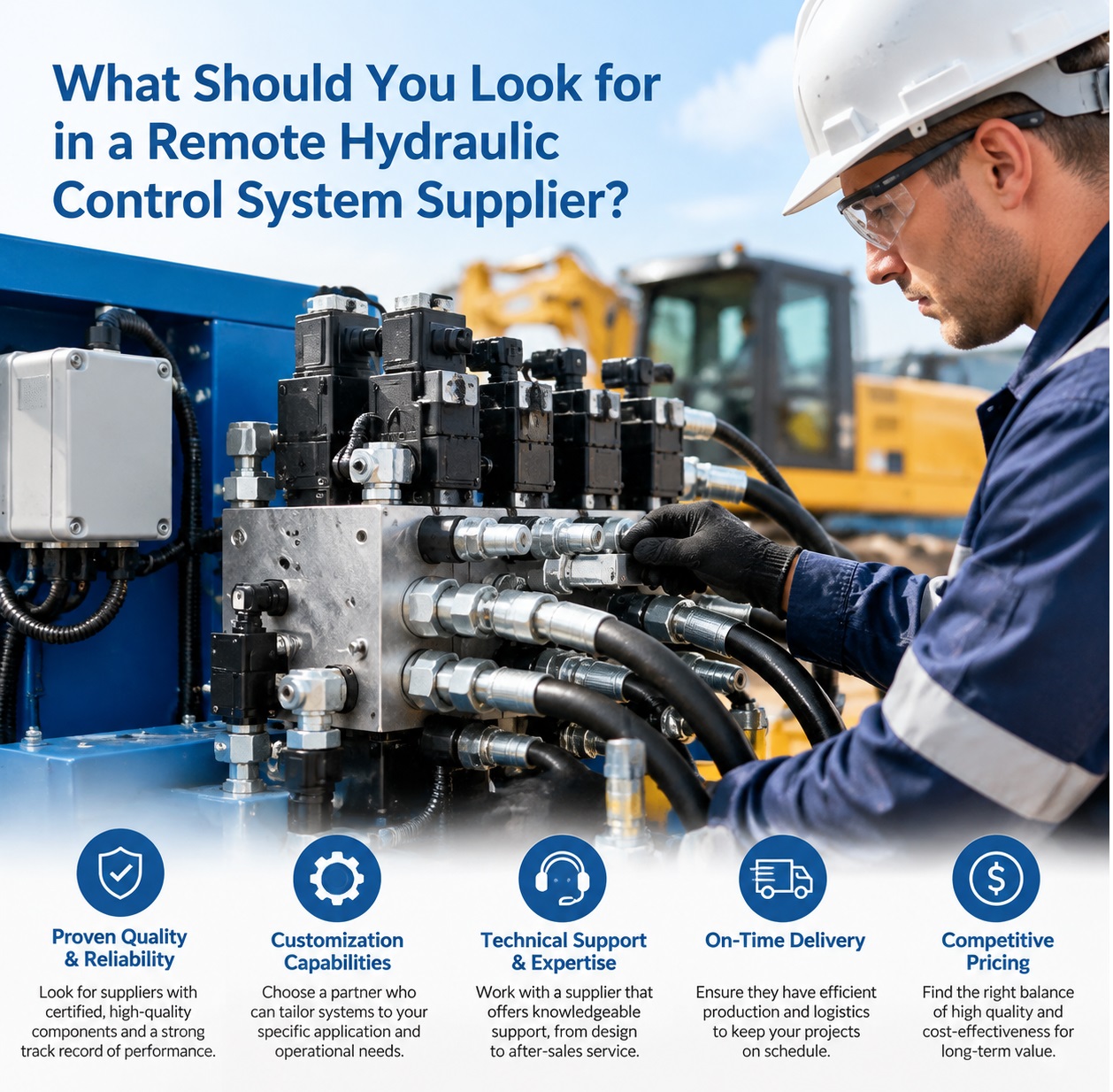
 A remote hydraulic control system is not a gadget you bolt on and forget. It is the difference between a machine that keeps working in mud, heat, vibration, and freezing rain and a service call that eats your margin. So when you vet suppliers, ignore the glossy brochure for a minute. The real question is simpler: can this company prove it understands what happens when electronics meet hydraulic pressure in the middle of nowhere?
Start with the enclosure, because that is where cheap suppliers get exposed. Ask for the IP or NEMA rating. Then ask how they tested it. A sticker that says IP67 means nothing if the connector leaks after a thousand pressure-wash cycles. Look for potted circuit boards, conformal coating, sealed Deutsch or AMP connectors, and a housing that survives UV, salt spray, and chemical exposure. If the supplier cannot tell you the temperature range without checking with engineering, that is your first red flag.
Next, talk about communication protocols like an engineer, not a shopper. Does the system speak CAN J1939, Modbus RTU, Modbus TCP, Ethernet/IP, or Profibus? Can it handle a proprietary protocol if your machine already uses one? More importantly, how does it behave when the network gets noisy? Remote hydraulic control lives near alternators, solenoids, and high-current cables. A supplier who talks only about features and never about latency, determinism, or error recovery is selling you a box, not a solution.
Safety is another place where marketing language falls apart. Ask about ISO 13849, SIL ratings, EMC testing, and relevant certifications such as CE, UL, CSA, or ATEX for hazardous locations. Do not accept a certificate as proof. Ask for test reports. Ask who signed them. Ask what happens during a loss of communication. A good supplier will have a fail-safe strategy built into the design, not bolted on after a customer complaint.
Then there is diagnostics. A remote hydraulic control system should tell you what is wrong before a machine goes down. Look for fault codes, event logging, real-time telemetry, and remote firmware updates. But remote access cuts both ways. Ask about cybersecurity. How are updates authenticated? Is data encrypted? Can a technician accidentally change a pressure setting from a laptop in the cab? The best suppliers treat remote access as a controlled tool, not an open door.
Hydraulic compatibility matters just as much as electronics. Your supplier should understand flow rates, pressure spikes, spool types, PWM signals, deadband, hysteresis, and calibration routines. They should know the difference between a proportional valve and a servo valve, and they should be comfortable working with the major hydraulic brands. If they cannot explain how their controller handles a pressure override or a stuck spool, keep looking.
Do not overlook the boring stuff. Lead times. Spare parts. Repair turnaround. Documentation. Training. Warranty terms. A supplier with a great product and a six-month lead time is not a great supplier. A supplier who cannot provide a wiring diagram in your language is not a great supplier. A supplier who disappears after the purchase order is signed is not a supplier at all. They are a liability.
Custom engineering is another differentiator. Some projects need a standard box. Others need a controller that fits a specific valve stack, a specific enclosure, and a specific machine profile. Ask how the supplier handles customization. Do they have in-house engineering, or do they outsource it? Can they build a prototype and validate it on a test rig? Will they share test data? The best suppliers will push back, ask questions, and suggest alternatives. The worst ones will say yes to everything and deliver nothing.
Finally, calculate total cost of ownership, not just unit price. A cheap controller that fails twice a season is expensive. A supplier who charges more but provides local support, fast spares, and a proven MTBF is cheap by comparison. Ask for field failure rates. Ask for references in your industry. Ask what happens when a product reaches end of life. If they cannot answer, you are not buying a system. You are buying a future headache.
The right remote hydraulic control system supplier will welcome the interrogation. They will ask about your environment, your operators, your data needs, and your maintenance team. They will talk about failure modes before you ask. They will show you test reports, not just certificates. They will treat the sale as the beginning of a relationship, not the end of a transaction.
So before you sign a contract, make a list. Enclosure protection. Protocol support. Safety compliance. Diagnostics. Hydraulic compatibility. Support. Spares. Customization. Total cost. Then ask every supplier to answer each point with specifics. The ones who can will stand out. The ones who cannot will save you a lot of trouble by walking away. And the supplier you choose should be the one who makes your machines more reliable, not just your purchasing spreadsheet look good.